Better Transportation, Bigger Markets
EU- and UNDP-supported research highlights how smarter, greener transport can turn Georgia’s strategic location into greater opportunities for small and medium-sized businesses.
Georgia’s strategic location in the Middle Corridor (Trans-Caspian International Transport Corridor) offers significant opportunities for a regional logistics hub and trade links with the European Union. However, for many Georgian businesses, particularly small and medium-sized enterprises (SMEs), getting their products to European markets remains costly and complicated.
Efficient, reliable, and increasingly sustainable transport links with European markets can turn this potential into lasting benefits for Georgian businesses and people.
A recently published study on Georgia’s Transportation System for Exporting Goods to EU Markets examines the challenges Georgian exporters face and suggests practical ways to make the country’s transport and logistics system more efficient, competitive, and inclusive.
The findings come at a pivotal time. The European Union is Georgia’s vital trading partner, accounting for more than a fifth of the country’s total trade in 2025 (about 12 percent of exports and 25.4 percent of imports). Under the EU-Georgia Deep and Comprehensive Free Trade Area (DCFTA), Georgian products enjoy preferential access to European markets, with SMEs driving almost 60 percent of Georgia’s exports to the EU. Source: GEOSTAT. External Merchandise Trade of Georgia 2025, Preliminary Data for 2025.
World Sustainable Transport Day
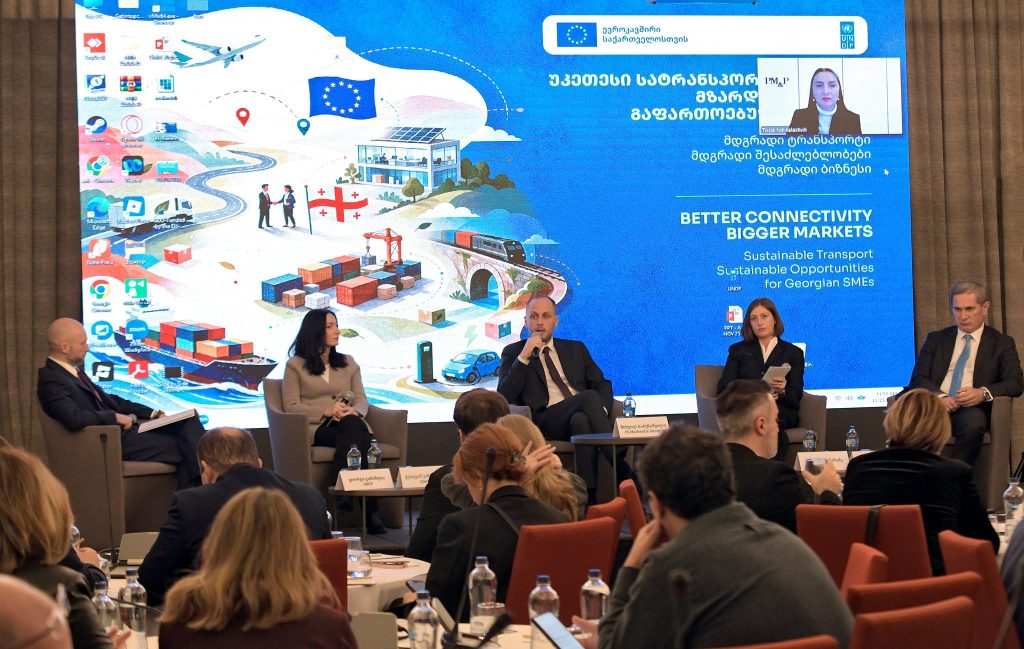
On 25 November, ahead of World Sustainable Transport Day and as part of the EU Green Diplomacy Weeks, the EU, UNDP, and Georgian research company ACT presented the study findings to representatives of small and medium-sized enterprises, business associations, transport and logistics operators, banks, international organisations, and diplomatic missions of the EU Member States.
The discussion highlighted growing private-sector interest in strengthening economic ties with the EU and tapping into the trade, investment, and growth opportunities offered by European markets.
Participants also explored practical solutions to make exporting to Europe faster, more affordable and sustainable, with a particular focus on addressing the logistics challenges facing smaller businesses.
“The EU accounts for more than a fifth of Georgia’s total trade, and small and medium-sized businesses drive almost 60% of Georgian exports to the EU. Our Deep and Comprehensive Free Trade Area gives them preferential access to a market of 450 million consumers, but high transport costs and delays still hold many of them back. Sustainability and trade go hand in hand. European buyers increasingly look at the environmental footprint of what they buy, and cleaner, more efficient transport and simpler procedures cut both costs and emissions for small exporters. Through new assistance of €38 million under our EU with You campaign, the European Union will create more opportunities for SMEs across Georgia to grow and reach European markets,” said Nicholas Cendrowicz, Head of Cooperation at the European Union Delegation to Georgia.
“Georgia has a unique opportunity to turn its strategic location into a real competitive advantage. But the Middle Corridor must work not only as a route for goods passing through the country, but also as a gateway for Georgian businesses to reach new markets. Better logistics services, stronger regional connections, and smarter digital solutions can help SMEs become more competitive, expand their exports, and contribute to sustainable economic growth,” said Douglas Webb, UNDP Resident Representative in Georgia.
Georgia’s Export Transport System
Key Findings
Conducted by the Georgian company ACT with support from the EU and UNDP, the research on Georgia’s Transportation System for Exporting Goods to EU Markets provides an integrated assessment of Georgia’s export transport system, identifies gaps in policy and practice, and outlines targeted recommendations for businesses, development partners, and public institutions.
Findings are based on a review of existing studies and policies, alongside in-depth interviews with Georgian SME exporters, transport and logistics companies, and other stakeholders.
The study reveals that large companies can often absorb high logistics costs by shipping full truckloads and containers, maintaining their own storage facilities and employing dedicated logistics teams. By contrast, SMEs struggle with fragmented shipments, limited access to cold storage, complicated customs procedures, and a lack of affordable transport options.
As a result, smaller businesses can pay 20–40 percent more per tonne to transport their goods than larger exporters. For producers of perishable goods, including wine, nuts, berries, fresh herbs and processed foods, these additional costs and delays can make European markets difficult to access and prohibitively expensive.
The challenges extend beyond transport costs. Around 75 percent of Georgia’s exports to the EU travel by sea, leaving exporters heavily dependent on Black Sea ferry connections and long overland routes. Ageing trucks, border bottlenecks, limited regional access to air cargo, insufficient cold-chain infrastructure, and weak coordination among logistics providers further undermine competitiveness.
Importantly, the study finds that some of the most significant improvements do not require major infrastructure investments. Many challenges stem from so-called ‘soft connectivity’: customs procedures, documentation, digital systems, regulatory alignment, and coordination between logistics providers.
These inefficiencies also carry environmental costs. Fragmented shipments and poor coordination can lead to greater resource use and less efficient freight transport. Addressing these bottlenecks can help SMEs become more competitive while making goods transport more efficient and environmentally sustainable.
Against this background, the study highlights the growing importance of sustainable transport. As European buyers increasingly consider the environmental footprint of their supply chains, modernising Georgia’s ageing truck fleet, reducing empty return journeys, and making better use of rail transport are becoming important not only for the environment but also for maintaining access to European markets.
To address these challenges, the research proposes a package of practical measures within the next 12 months and broader reforms over several years.
The message is clear: A more efficient, sustainable, and inclusive transportation system can help Georgia move beyond its traditional role as a transit country and become a competitive regional logistics and production hub connecting Europe and Asia. Above all, it can help Georgian businesses turn preferential access to EU markets into tangible export opportunities and sustainable growth.
About the European Union
For more than 30 years, the European Union has built a close partnership with Georgia, supporting its development through knowledge, experience sharing, expertise, innovation, and financial aid. Ties between the EU and the Georgian people are based on shared values of peace, freedom, democracy, human rights, and inclusive economic growth.
More about the EU’s support for Georgia: https://eu4georgia.eu/the-european-union-in-georgia, https://eu4georgia.eu/new-eu-assistance
Inclusive Access to Markets
With funding from the European Union and in partnership with the Estonian Centre for International Development (ESTDEV), UNDP is implementing the Inclusive Access to Markets initiative, empowering Georgian SMEs to build their capabilities, enhance value chains, and secure access to the EU and European markets. The four-year project (2023-2027) is funded by the European Union (EUR 5,000,000) and co-funded by UNDP (EUR 162,000).